| HARTLEY'S UNDERSEA WALK BERMUDA |
DEPARTURE POINT & PROCEDURES FOR HARTLEY'S HELMET DIVING |
 As with all fun watersports activities such as scuba diving, parasailing, jet skiing,and bell diving, Bermuda insurance requires a waiver to be signed.
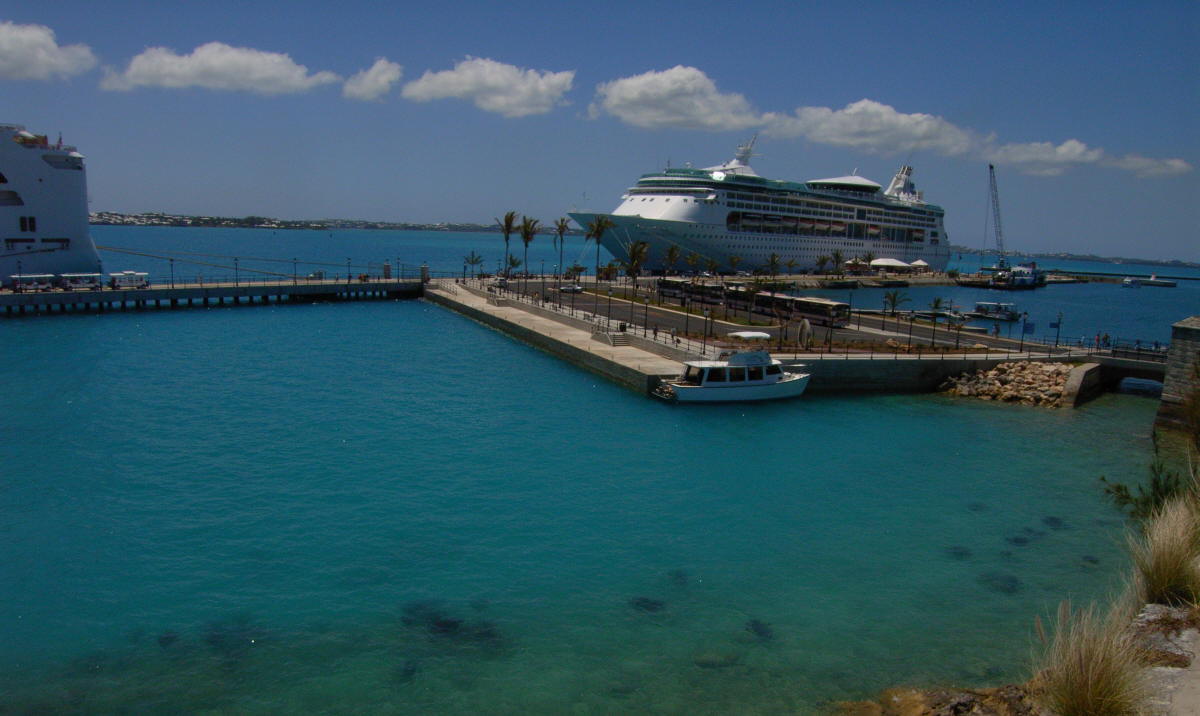
If you have been diagnosed with any heart or breathing problems you will need a note from a doctor allowing you to dive in 10ft of water and engage in mild physical activity. If you find walking up one flight of stairs gives you breathing difficulty, then perhaps you could come for half price as a rider.Click here to see the waiver.Hartley's departure point is next to the Moongate at Heritage Wharf, Dockyard. Starting from the ferry dock, you walk as if you are trying to get to the ships. After you walk past the big concrete pillars holding up big metal gates you will cross a very small bridge. On the right hand side of the above photo. You will see a moongate on your left. Go through the moongate and there will be steps right in front of you leading down to a dock. The new cruise ship dock, Heritage Wharf, will be on your right and the high walls encircling the tip of Dockyard will be on your left. Look for our white 40ft boat, Rainbow Runner, which has golden diving helmets on the back. The upper photo is taken from the top of the fortifications of Dockyard looking south. The Norwegian Spirit is to the right and the Enchantment of the Seas is to the left at the original dock, Kings Wharf. Our boat is in the foreground with the moongate(Circle of stone which looks like a 'Stargate') just above the front of the boat. Click on photo to enlarge, then click the back button on your upper left. |
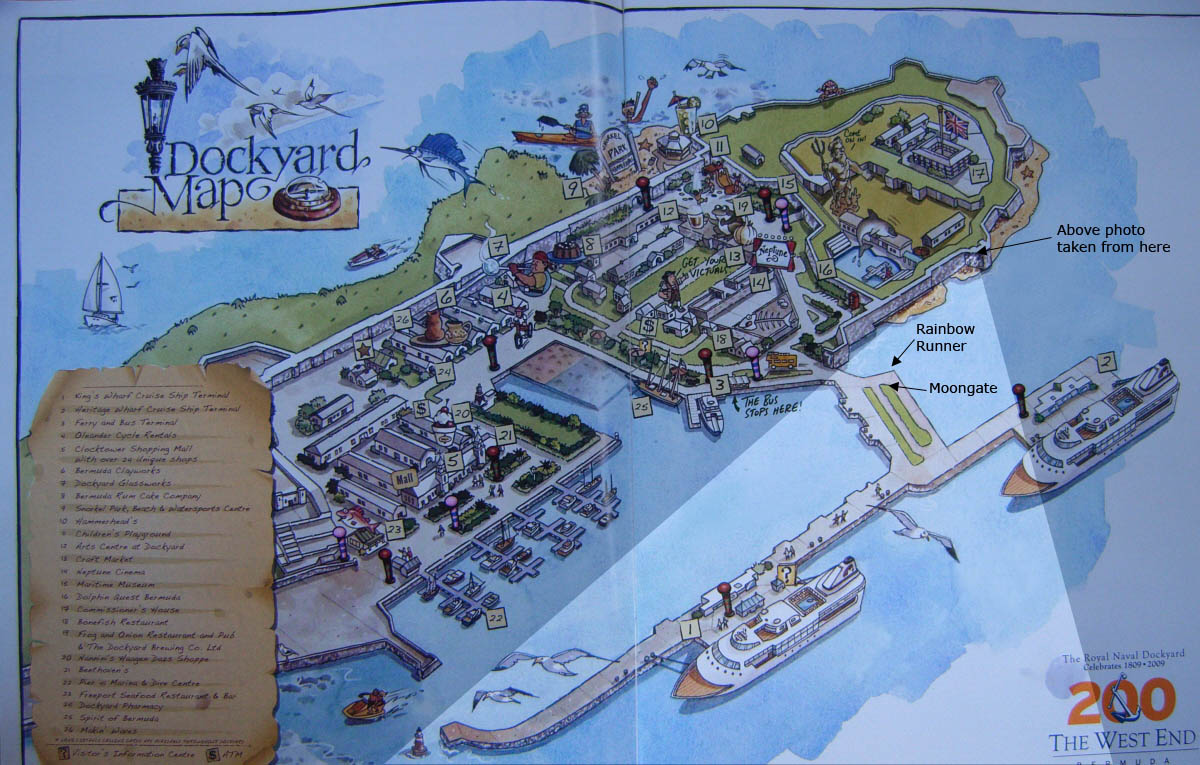 This is a photo of a map of Dockyard which shows the new berth called Heritage Wharf (Labeled 2), and below it King's Wharf (Labeled 1). The ferry dock is #3. Look in the photo for labels, 'Above photo taken from here', as well as 'Moongate' and 'Rainbow Runner'.(Our dive boat).
Click here to see a satellite view of DockyardThe image is centered on the dock corner being used by the boat in the top photo. The Visitor's Information Center, where you can use their phone to call us (offer to pay 50cents), is on the for right of the image next to the minus button. The shops, Clocktower Mall and Dockyard Glassworks are all off to the left. Check-in time is 30 minutes before departure. Payment can be by traveler's checks, major credit cards, and even cash. Undersea digital photos on a CD are available. Our 2013 prices are $95 per diver and half price for those just observing. Charter rates are also available. |
|
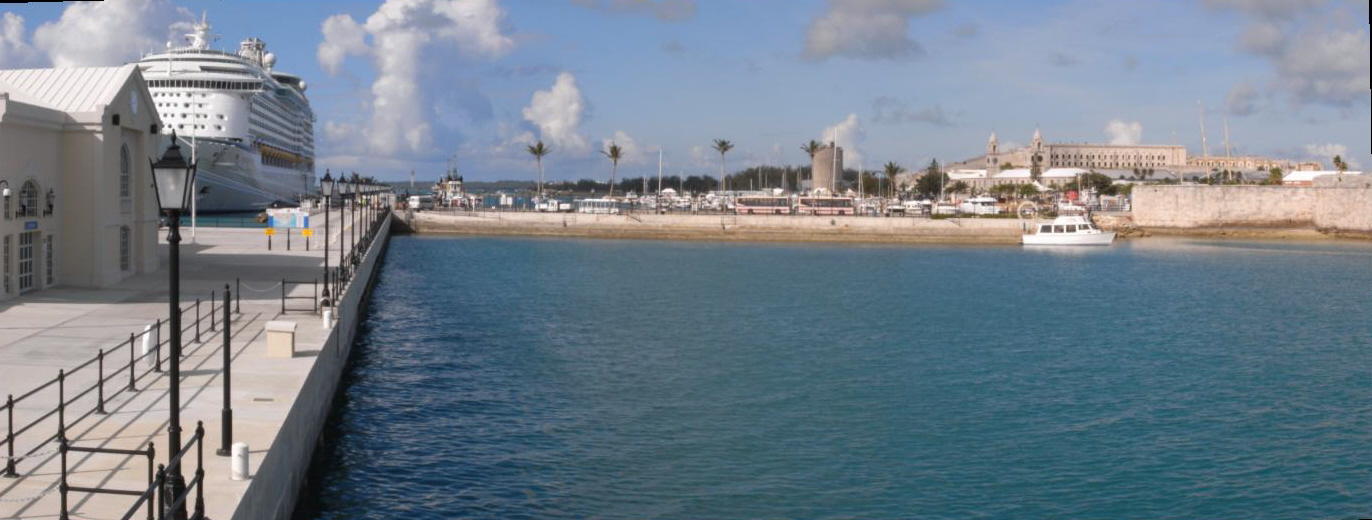
| This photo is taken from near the end of Heritage Wharf looking southwest. The arrivals shed is on the far left. In the left background you see a Celebrity or RCCL ship at Kings Wharf. Continuing towards the right there is a taxi and bus parking. The concrete silo is in the middle, background above the buses. In the second photo up the concrete slilo is just below the 'Y' of Dockyard. You can also see the two towers of the Clocktower Mall. Below the twin towers is the Moongate. Below the Moongate is the back of our boat. Our boat is turned 90 degrees from the position of the top photo. To the far right is the wall of the fortification of Dockyard near from where the top photo was taken. |
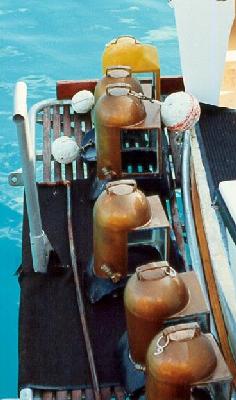 During the 30-minute ride to the reef I explain how the diving helmet works, what the dive will be like, and
what sea creatures you will be seeing. At the reef we pick up our mooring ropes (anchors damage the reef), and
position the boat bow into the wind for comfort. Divers rarely get seasick because our reef is inside the
barrier of reefs around Bermuda which prevents ocean swells and big waves from reaching us. Bermuda is on the top of an extinct volcano. The southerly currents made the coral grow on the southern side faster, so that is why there is land there. The western and northern edge of the crater comes within a few feet of the surface and is crowned with reefs. The inside of the crater is called the platform and is about 30 to 40 feet deep. It is dotted with reefs called flats. The flats are ringed with reefs and have an area in the middle which is about eight to ten feet deep and is dotted with reefs. The reef we use is called Half Way Flat because it is half way from the shore to the outer reef's edge. Our spot is nestled in an indentation on the northern side. This means we can handle strong winds any where form the west through the south to the east. We are very sensitive to wind out of the north as we have no protection from the reefs.
During the 30-minute ride to the reef I explain how the diving helmet works, what the dive will be like, and
what sea creatures you will be seeing. At the reef we pick up our mooring ropes (anchors damage the reef), and
position the boat bow into the wind for comfort. Divers rarely get seasick because our reef is inside the
barrier of reefs around Bermuda which prevents ocean swells and big waves from reaching us. Bermuda is on the top of an extinct volcano. The southerly currents made the coral grow on the southern side faster, so that is why there is land there. The western and northern edge of the crater comes within a few feet of the surface and is crowned with reefs. The inside of the crater is called the platform and is about 30 to 40 feet deep. It is dotted with reefs called flats. The flats are ringed with reefs and have an area in the middle which is about eight to ten feet deep and is dotted with reefs. The reef we use is called Half Way Flat because it is half way from the shore to the outer reef's edge. Our spot is nestled in an indentation on the northern side. This means we can handle strong winds any where form the west through the south to the east. We are very sensitive to wind out of the north as we have no protection from the reefs.
Click here to see an ariel view of our dive site.The boat is usually between the southwestern side of the small circular reef on its own, and the thick edge of the flat itself. We dive in the comma shapped area below the small circular reef in the center of the image. Zoom out and in to get your perspective. Then hit back to return. This links to an extremely addictive fun site that will have you playing for hours exploring the globe, instead of researching your trip to Bermuda. |
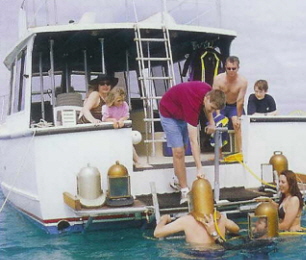
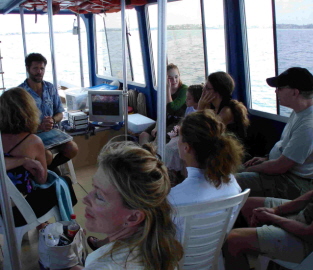 The 25-30 minute dives are arranged in groups of six or seven. Amazingly in 2005 we had only three trips with 5 dives and three with only one. The number of trips with two dives was equal to the number of trips we had four dives. Three dives occured the most often-a perfect bell curve.
We have a glass bottom, fish books, games, sunbathing deck or conversation to keep you busy while
waiting for the other dives. Or you can Zen out and do nothing but de-stress and watch the white puffy clouds
and turquoise water. We have two ounce bags of cookies for 75 cents to keep young and/or hungry mouths busy. Hot chocolate and full length wetsuits are provided when the water is below 80°f. Hot chocolate and black currant juice are complementary self serve items. The first couple walks down the ladder till the water reaches their shoulders (the first
three rungs of the ladder are flat and very wide for tender feet). After the helmet, which is heavy only on
land, is gently placed on your shoulders, you walk to the bottom. For most people it is only about four rungs to the sea bed.
Click here to see tide, sunrise/sunset timetable.
At spring low tide the ladder would hit the bottom at high tide there can be up to a three foot hop, which is done very easily underwater- especially with my assistance.
The 25-30 minute dives are arranged in groups of six or seven. Amazingly in 2005 we had only three trips with 5 dives and three with only one. The number of trips with two dives was equal to the number of trips we had four dives. Three dives occured the most often-a perfect bell curve.
We have a glass bottom, fish books, games, sunbathing deck or conversation to keep you busy while
waiting for the other dives. Or you can Zen out and do nothing but de-stress and watch the white puffy clouds
and turquoise water. We have two ounce bags of cookies for 75 cents to keep young and/or hungry mouths busy. Hot chocolate and full length wetsuits are provided when the water is below 80°f. Hot chocolate and black currant juice are complementary self serve items. The first couple walks down the ladder till the water reaches their shoulders (the first
three rungs of the ladder are flat and very wide for tender feet). After the helmet, which is heavy only on
land, is gently placed on your shoulders, you walk to the bottom. For most people it is only about four rungs to the sea bed.
Click here to see tide, sunrise/sunset timetable.
At spring low tide the ladder would hit the bottom at high tide there can be up to a three foot hop, which is done very easily underwater- especially with my assistance.
| |
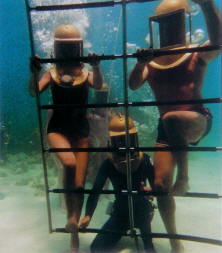
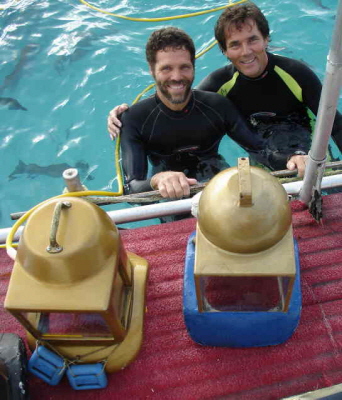
Swallowing, yawning or just wiggling your jaw up and down will allow the increasing pressure to get to the other side of your ear drums. If you have had a cold recently then you may have to reach inside your helmet (no, water will not come in), hold your nose, close your mouth and blow gently. Each time you exhale you will hear the air bubbling out. When you breathe in, it is quieter and you can hear the air as it comes out of the hose attached to your helmet.As you walk down the ladder you will notice that your hands look bigger and closer than they really are. When looking from air to water, through a flat window, everything is magnified by about one third. The same goes for looking at an aquarium. As you descend you will see the bottom of the boat and the propellor. Snappers usually hang out in formation pointing into the current. | |
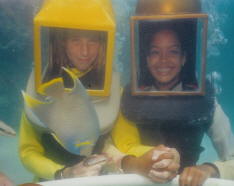
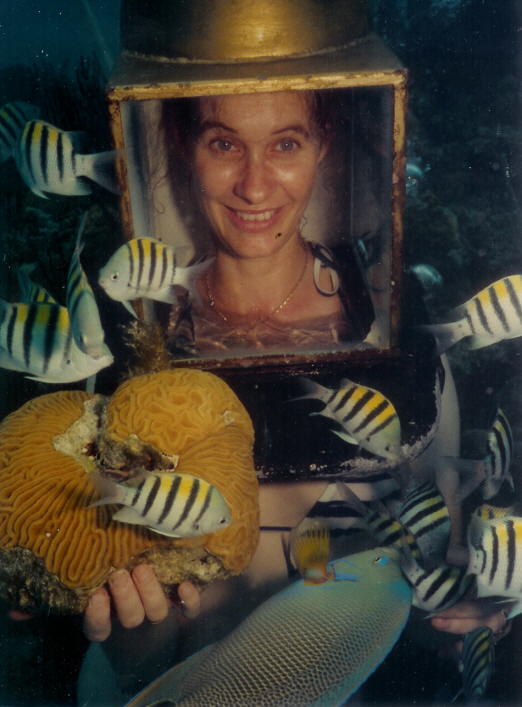 Once on the bottom all divers hold a seven-foot long PVC pipe, which keeps us in a close group
and allows everybody to see the show. I get each pair of divers to kneel on the sandy bottom and hang on to the grab-bar, once they have assured me their ears are OK.Then we identify some of the fish with the message stick while the dust moves away. Then we take the digital photos. Then we stand up and walk with knees bent to the first kneeling down spot right up close to the reef. I pass samples of living creatures that either live on the bottom or have been broken off by storms. We demonstrate the filtering action of the sponges and let you see corals respond to the human touch. Most of the interesting details of the dive should be for you to discover
for yourself. Some divers are quite inspired by their dive It is a fantastic adventure you should not miss. Your walk undersea will be the highlight of
your trip or cruise to Bermuda.
Once on the bottom all divers hold a seven-foot long PVC pipe, which keeps us in a close group
and allows everybody to see the show. I get each pair of divers to kneel on the sandy bottom and hang on to the grab-bar, once they have assured me their ears are OK.Then we identify some of the fish with the message stick while the dust moves away. Then we take the digital photos. Then we stand up and walk with knees bent to the first kneeling down spot right up close to the reef. I pass samples of living creatures that either live on the bottom or have been broken off by storms. We demonstrate the filtering action of the sponges and let you see corals respond to the human touch. Most of the interesting details of the dive should be for you to discover
for yourself. Some divers are quite inspired by their dive It is a fantastic adventure you should not miss. Your walk undersea will be the highlight of
your trip or cruise to Bermuda.
|
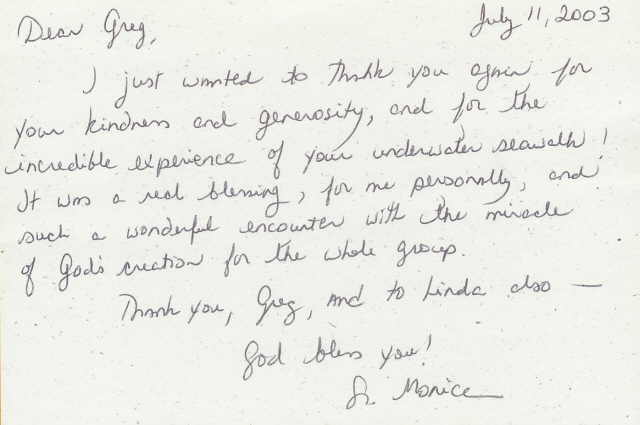
| Teenager Impressed When I first heard of this I thought it would be dull and corney. Then when I got on the boat and got a big talk on it, then I thought it would last 20 seconds and be over. I never knew I would have such a good time. It was great, and I would do it again if I had the time. Age 13 Chris Ackad 13516Travilah Rd. North Potomac. MD viper37844@aol,com 20878 |
 |
1-866-836-3989
between 8am and 9pm EST